
Saving Smiles, Preserving Teeth
Book
appointments
in advance
Let our specialist talk to you
No. 1
Dental Clinic in Bengaluru
25K+
Patients treated this far
25+
Years of Combined Experience
3
Caring Locations
Home » Root canal
ROOT CANAL
A root canal is a dental procedure used to treat a severely damaged or infected tooth. Inside each tooth, there is a soft tissue called the dental pulp, which contains nerves, blood vessels, and connective tissues. When the dental pulp becomes infected or inflamed due to deep decay, cracks, trauma, or other reasons, it can cause intense pain and discomfort.
The root canal procedure aims to alleviate pain, save the natural tooth, and prevent further infection or spread of the problem to surrounding teeth or tissues. It is a common and effective treatment to preserve a damaged tooth and maintain a healthy smile. At Ridgetop Dental International, our endodontist are specialized in microscopic endodontic procedure which provided a high grade of precision, lower appearance of pain and avoids the recurrence of the treatment.
Persistent and severe toothache: Intense pain when biting or applying pressure to the tooth.
Sensitivity to hot or cold temperatures: Experiencing discomfort or pain when consuming hot or cold foods/drinks.
Swelling or tenderness in the gums: Presence of a pimple-like bump on the gum near the affected tooth.
Darkening or discoloration of the tooth: The tooth may appear darker than surrounding teeth.
Gum abscess: Formation of a pus around the tooth’s root, causing localized swelling and pain.
Note – The mentioned symptoms above do not apply to every case scenario. Hence, a consultation with our endodontist will give you a better understanding on the required treatment procedure.
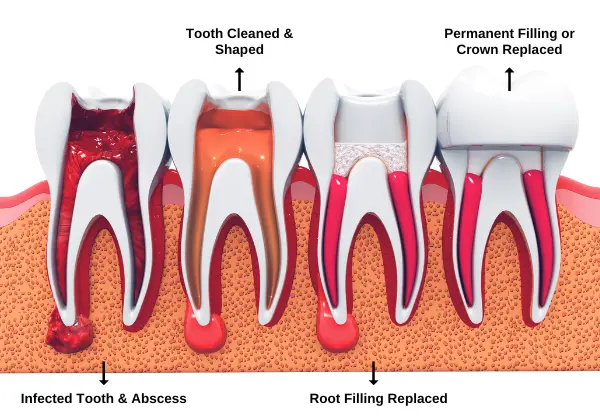
Local Anesthesia: The dentist will administer local anesthesia to numb the area around the affected tooth, ensuring you don’t feel any pain during the procedure.
Accessing the Pulp Chamber:The dentist will create a small opening in the tooth’s crown to access the dental pulp and root canals.
Removing the Infected Pulp: The dentist will carefully remove the diseased or damaged dental pulp from the root canals using specialized tools. After that, the canals are cleaned and prepared for filling.
Cleaning and Disinfection: The root canals are thoroughly cleaned and disinfected to remove bacteria and debris.
Filling the Root Canals: After cleaning, the dentist fills the root canals with a biocompatible material, typically gutta-percha. This filling material seals the canals to prevent future infection
Sealing the Tooth: The access opening in the tooth’s crown is sealed with a temporary or permanent filling material.
Restoring the Tooth: In many cases, a dental crown is placed over the treated tooth to protect it and restore its strength and appearance.
The entire root canal procedure is usually completed in one or two visits, depending on the complexity of the case and the tooth’s condition. After the root canal treatment, the tooth should function normally, free from the pain or infection that prompted the procedure. To restore the tooth with the crown two visits will be required
Our specialist for
root canal treatment

Dr. Naveena Ponnada
Associate Surgeon -
Restorative Dentist & Micro-Endodontist
BDS, MDS - Restorstive Dentist & Micro-Endodontist
6+ Years of Experience
Speciality:
Root Canal Treatment, Re-Root Canal Treatment, Microscopic Root Canal, Tooth Filling, Tooth Fracture, Tooth Sensitivity, Teeth Whitening, Crowns, Dental Veneers, Surgical & Non-Surgical RCTs.

Dr. Charu Sonegare
Associate Surgeon - Restorative Dentist & Micro - Endodontist
BDS, MDS - Restorstive Dentist & Micro-Endodontist
3+ Years of Experience
Speciality:
Root Canal Treatment, Re-Root Canal Treatment, Tooth Filling, Teeth Whitening, Crowns, Veneers and Surgical & Non- Surgical RCTs
Patient Testimonials

FAQs On Root Canal Treatment
A root canal treatment is a dental procedure designed to save a tooth that has a damaged or infected pulp (the innermost part of the tooth).
Root canals are typically performed when a tooth has deep decay, a cracked tooth, trauma, or an infected pulp. They help alleviate pain, save the tooth, and prevent further complications.
Common signs include severe toothache, sensitivity to hot or cold, swollen gums, and a pimple on the gum. Only a dentist can determine if a root canal is necessary through examination and X-rays.
The duration varies depending on the tooth’s complexity, but it typically takes one to two appointments.
The primary alternative is tooth extraction, but it's generally recommended to preserve natural teeth whenever possible.
In most cases, a crown is recommended to protect the tooth, as root canal treatment can make the tooth brittle over time.
You may experience some mild discomfort or swelling for a few days, but this is usually manageable with pain relievers.
Yes, root canals are a safe and common dental procedure performed by experienced dentists
Book appointments
in advance
Let our specialist talk to you
our services